

Everything comes back as a trend. Not just style and fashion but behavior too. I’ve been thinking a lot about generational behavior and the little surprises that show up when you stop scrolling long enough to actually watch how people live.
Quick disclaimer before anyone files a complaint with the Department of Generational Studies. I haven’t run a formal focus group. No clipboards. No “rate your feelings about landlines on a scale of 1 to 10.” This is mostly observation, overheard conversations IRL and some internet sleuthing.
As a Gen Xer, there are days I crave my life in the 90s, especially my twenties. It felt simpler. Tech was barely present and not attached to our nervous systems. Connection was the point, not content. We met people because we left the house, not because an app decided we needed “community.”
We learned by doing, by asking friends, by making questionable choices and living to tell the story. I didn’t have Google. I definitely didn’t have ChatGPT. If I wanted an answer, I had to do the unthinkable, figure it out myself or ask a human being.
Which got me wondering, can we be nostalgic without judging our present day?
Because nostalgia gets messy fast. Our parents, the Boomers, will drop lines like “it’s not like the old days” or “when I was your age…” like they are reading from a script that comes preinstalled at age 65.
And I get it. Nostalgia is comforting. It’s warm. It’s familiar. It’s the emotional equivalent of a cozy cashmere sweater.
But I want to believe we can fantasize about the cozy feelings nostalgia brings without turning it into a constant critique of how life is now.
Do we really want to go back or do we just want to borrow a few things we miss? Less noise. Less pressure. Less performance. More presence. More laughter that’s not recorded. More time that doesn’t feel like it is being auctioned off to the highest bidder.
Here is the twist I didn’t fully expect. Observing life as a twenty something in 2026 through the lens of my nephew and his friends, I see a craving that feels extremely familiar. Gen Z, the generation raised in the most digital environment ever, is low key romanticizing the analog principles Gen X lived by in the 90s.
They thrift. They hang out in person. They do trips with friends. They work jobs that pay enough to get by and then spend the rest of their energy trying to have an actual life. And yes, they listen to our music, which is both flattering and mildly annoying in the way only truth can be.
My nephew even bought a Walkman. A Walkman. Which is weird to me for two reasons. First, where are you even finding cassette tapes in 2026? Second, are we all just pretending those little foam headphones did not sound like Minnie Mouse singing from inside a tin can?
But the “analog comeback” is not just a quirky aesthetic thing. There is real data behind the shift. Thrift and resale are not a niche hobby anymore, but let’s not rewrite history like Gen Z invented the thrill of finding a perfectly broken in leather jacket.
Back in the early 90s, thrift shopping was already all the rage. It was the Grunge Era, and everyone was hunting for secondhand gold like their social life depended on it.
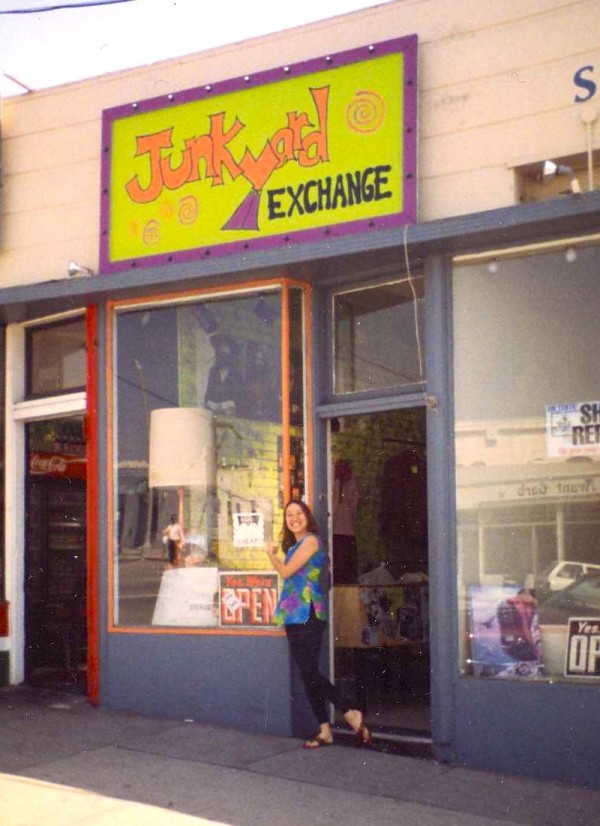
My first business was a vintage clothing store, Junkyard Exchange, and I swear I could not keep enough used Levi’s in the place. I’d get wiped out. Like someone put “vintage 501s” on a wedding registry. And what’s funny is that sometimes I wish I still had the shop today because the current resale boom is basically that same energy, just with better lighting and more people calling it “curated.”
The stats backs up how mainstream it’s now. One roundup of thrifting statistics reports that 34% of Gen Z consumers always shop at thrift stores and that 2 out of 5 items in the average Gen Z closet are secondhand.
It’s proof that behavior cycles the same way fashion does, when the world gets chaotic, we reach for what feels grounding.
And it’s not just clothes. Physical media is having a moment again and Gen Z is a big part of it. In the US, the RIAA reported that vinyl revenue grew again in 2024, reaching about $1.4 billion.
That’s wild when you remember Gen Z grew up with streaming as the default. But maybe that’s the point. Streaming is convenient but it’s also intangible. You don’t own anything. It can disappear. It’s background noise. Vinyl is an object. It’s intentional. It makes listening feel like an activity again.
On the social side, there’s also a clear hunger for real world connection. Eventbrite has been talking about Gen Z and Millennials creating “fourth spaces,” basically gatherings that turn online interests into real life connections.
Spotify’s Culture Next research has also pointed to Gen Z craving in person experiences and using live events as a way to reconnect. Translation: even the most digital generation is trying to crawl out of the group chat and into the living room.
So where does that leave Gen X in all of this?
Because while Gen Z is flirting with analog, Gen X has spent the past couple decades adapting to everything new. Social media. AI. Uber. Online banking. Electric cars. Making money online. Even listening to newer artists without acting like anything released after 1999 is automatically trash.
We have become bilingual, meaning, we can do both nostalgia and modern life. We remember the before but we function in the now.
And maybe that is the real point of this whole generational mirror moment.
Gen Z is not trying to become Gen X. They are trying to protect their attention, their mental space, and their sense of self in a world designed to constantly extract all three. Gen X is not trying to become Gen Z either. We are just trying to use technology without letting it use us.
Both generations, in their own way, are asking the same question, “how do I live a real life in a world that keeps trying to turn my life into content?”
So here’s what I keep coming back to…
Nostalgia doesn’t have to be a complaint. It can be a compass.
You can miss the 90s without pretending the 90s were perfect. You can love the simplicity of “back then” while still building something meaningful now.
AND you can borrow the best parts of older eras, like more face-to-face time, more play, more privacy, more patience and bring them into present day life like a mixed tape you made for your bestie.
Maybe the goal is not going backward. Maybe the goal is choosing what is worth bringing forward.
And honestly, if Gen Z wants to thrift like we did, listen to our music and romanticize the idea of life being more human, I say let them.
Just one request…
Please rewind the tape gently. Some of us are still emotionally recovering from the sound a cassette makes when it gets eaten.